What is an argument?
An argument is more than a mere assertion. It consists of a claim and the reasons meant to support it. Whoever argues therefore does not just assert something, but also provides reasons for it.
Structure: premises and conclusion
An argument has two building blocks:
- Premises: the statements (reasons, evidence, assumptions) that we put forward to support our claim. The conversation partners should hold the premises to be true; but each reason can also be accepted or rejected.
- Conclusion: the claim that we try to support, that we hold to be true and that is in principle contestable.
- All humans are mortal. (Premise 1)
- Socrates is a human. (Premise 2)
- Therefore Socrates is mortal. (Conclusion)
Recognizing premises and conclusion
In natural language the building blocks often give themselves away through signal words:
- A conclusion is often introduced by: therefore, hence, thus, consequently, so.
- A premise is often introduced by: because, since, for, due to, after all.
These words are useful signposts, but they are sometimes missing altogether. Then we have to work out for ourselves which statement is meant to be supported (conclusion) and which one supports it (premise).
Central terms
For the following chapters a shared vocabulary is useful:
- Argument: a combination of premises and a conclusion in which the premises are meant to support the conclusion.
- Premise: a supporting statement (a reason) of an argument.
- Conclusion: the statement that is meant to be supported by the premises.
- Validity: an argument is valid if the conclusion follows from the premises — if the premises are true, the conclusion must be true too. Validity concerns only the form, not the truth content of the premises.
- Soundness: an argument is sound if it is valid and its premises are actually true. Only sound arguments really give us good reasons.
Valid = the conclusion follows from the premises. Sound = valid and the premises are true.
The Toulmin model: a universal way to describe arguments
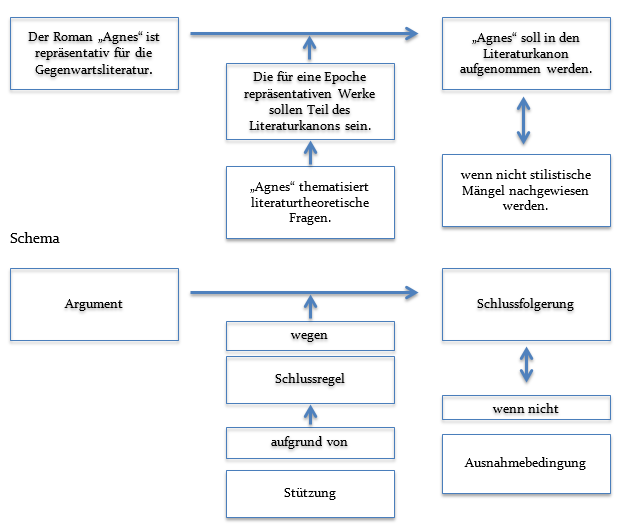
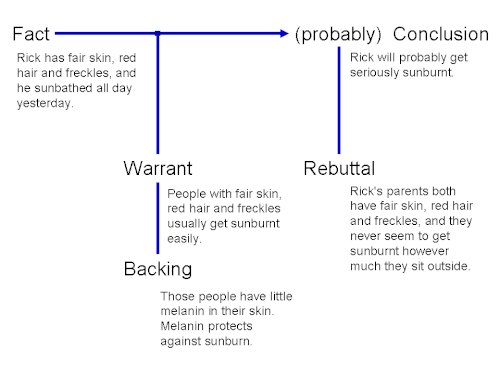
The British philosopher Stephen Toulmin developed a model that makes the internal construction of an argument visible. At its center is the claim, the contested statement we want to support. It rests on the data (facts), the undisputed evidence. The bridge between data and claim is the warrant: a mostly unspoken rule that explains why the data carry the claim. The warrant itself rests on the backing, that is, on experiential knowledge, laws or theories. The qualifier indicates how certain the claim is ("presumably", "as a rule"). Finally, the rebuttal names conditions under which the argument does not hold. In this way the model makes the hidden assumptions and weak points of an argumentation explicit.
Here is a diagram that illustrates this:
Here is an example from the English Wikipedia. It uses the original terms such as Fact, Conclusion, Warrant, Backing, Rebuttal:
Our syllogism from the beginning would look like this here:

How to use this model to break down a concrete argument we will see in the part Analyzing arguments.