Analyzing arguments
In everyday life we rarely encounter arguments in clean form. Reasons and claim are jumbled together, some things remain unspoken, and rhetorical embellishments hide the actual structure. To analyze an argument means to free it from this packaging and make its logical core visible.
Recognizing premises and conclusion
An argument consists of two sorts of statement: the premises, that is, the reasons, pieces of evidence and assumptions, and the conclusion, the statement that is to be supported by them. Premises can be stated explicitly or presupposed tacitly, and in a larger context a conclusion can itself serve as a premise again.
When reading and listening, the two sorts often give themselves away through signal words:
| Premise signals | Conclusion signals |
|---|---|
| because, since, for, due to, after all, given the fact that | therefore, hence, thus, consequently, so, it follows that, this shows, this proves |
If such words are missing, a simple pair of questions helps: "What is being claimed?" leads to the conclusion, "Why should I believe that?" leads to the premises.
Reconstructing an argument
A reconstruction usually follows these steps:
- Find the conclusion. Ask: What does the speaker want to convince me of? Signal words such as therefore, hence, thus help. Often the conclusion stands at the beginning or the end.
- Collect the premises. Ask: Which reasons are put forward for the conclusion? Signal words are because, since, for.
- Add hidden assumptions. Ask: What additionally has to hold for the reasons to carry the conclusion? These implicit premises are often the real weak point (see Recognizing hidden assumptions).
- Put it into standard form. Write the premises down numbered and the conclusion below them. This makes the structure testable.
Statement: "You shouldn't eat this mushroom, it could be poisonous, after all you don't know it."
Reconstruction in standard form:
- (Premise) You don't know this mushroom.
- (implicit premise) Mushrooms that one does not know could be poisonous.
- (implicit premise) What could be poisonous should not be eaten.
- (Conclusion) You should not eat this mushroom.
Applying the Toulmin model
For more complex arguments the Toulmin model helps, because it not only separates premises and conclusion but also makes the bridge between them and the limits of the argument visible. One questions the argument step by step:
| Question | Toulmin element |
|---|---|
| What is being claimed? | Claim |
| What does it rest on? | Data (facts) |
| Why do these data carry the claim? | Warrant |
| What does this warrant rest on? | Backing |
| How certain is the claim? | Qualifier |
| When does it not hold? | Rebuttal |
Here is a diagram from the English Wikipedia. It uses the original terms such as Fact, Conclusion, Warrant, Backing, Rebuttal:
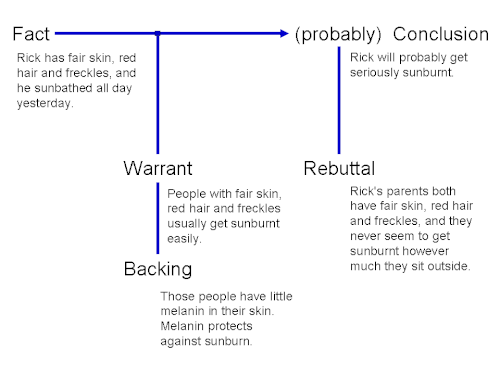
Our Socrates syllogism from the beginning would look like this here:

Statement: "Harald is presumably criminally responsible, for he is 16 and thus over 14, and in Germany one is criminally responsible from the age of 14 — unless an expert opinion certifies that he lacks maturity."
- Data: Harald is 16 years old.
- Claim: Harald is criminally responsible.
- Warrant: Whoever is over 14 is criminally responsible.
- Backing: Section 19 of the German Criminal Code (StGB) sets criminal responsibility from the age of 14.
- Qualifier: "presumably".
- Rebuttal: unless an expert opinion certifies a lack of maturity.
From breaking down to evaluating
Only the reconstruction makes a fair evaluation possible. With the exposed structure you can check in a targeted way:
- Are the premises true or at least defensible?
- Are they relevant to the conclusion and do they support it sufficiently? (see Characteristics of good arguments)
- Does the warrant really hold, or is there a questionable assumption hidden in it?
- Does a rebuttal apply that undermines the argument?
How much this is worth becomes clear as soon as an argument stands in standard form: mistakes that sound plausible in running text then leap out at you.
Statement: "Since all planets of our solar system orbit the Sun and Pluto orbits the Sun, Pluto must be a planet of our solar system."
Reconstruction in standard form:
- (Premise) All planets of our solar system orbit the Sun.
- (Premise) Pluto orbits the Sun.
- (Conclusion) Pluto is a planet of our solar system.
Evaluation: Both premises are true, and yet the conclusion does not follow. The argument confuses a necessary with a sufficient condition: orbiting the Sun is necessary for a planet, but it is not enough, otherwise asteroids and comets would be planets too (see Necessary versus sufficient conditions).
On the next pages we go deeper into tracking down hidden assumptions and practice the analysis on concrete examples.
Artikel auf Deutsch | Article en français